
How Sharing Funny Pictures Keeps Long-Distance Friendships Alive
Discover how sharing funny pictures and inside jokes helps distant friends keep in touch, share ordinary moments and maintain connection.
Your best friend lives three time zones away. You haven't seen each other in person for months, yet you still know their opinion of the new office coffee machine because they sent you a photograph of a devastated cartoon character at 7:14 a.m. local time.
Funny pictures give long-distance friends an easy way to remain part of each other's ordinary days. They can remind someone of a shared joke, celebrate a tiny victory or simply announce that you have spotted another animal with an expression remarkably similar to their landlord.
Small messages keep familiar conversations moving
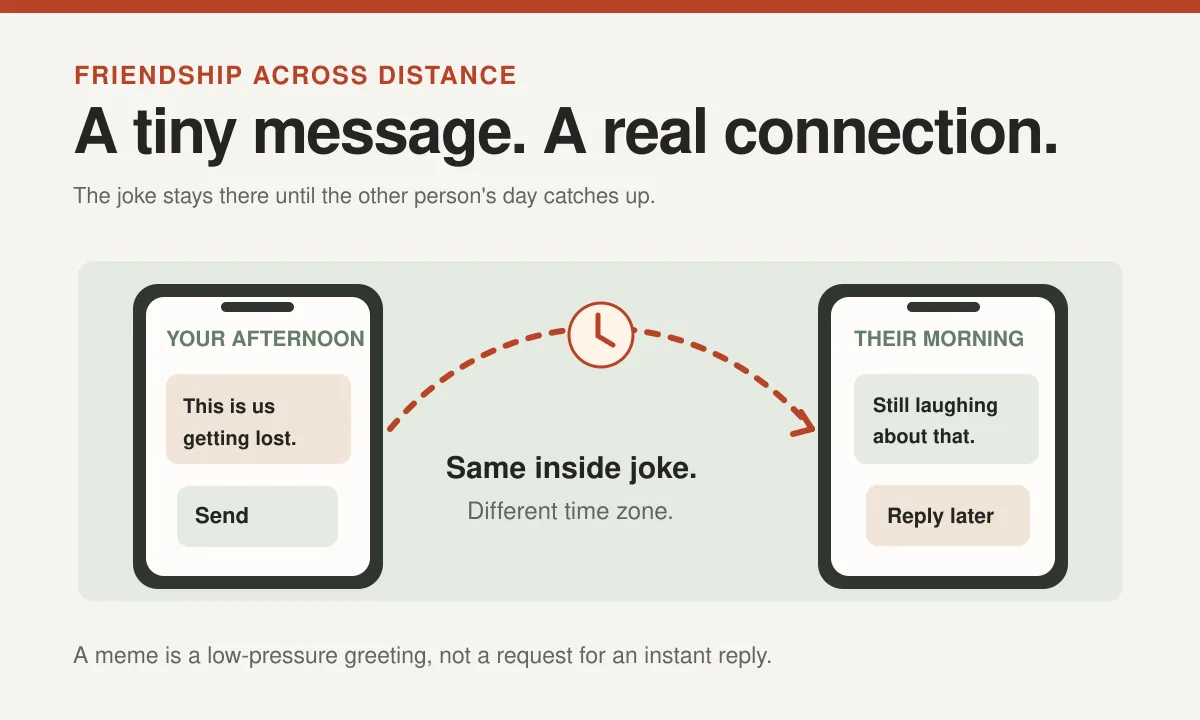
Distance makes spontaneous visits difficult. A quick meme, however, can travel while one person is commuting and the other is making dinner. Nobody needs to synchronize calendars or prepare an agenda for the exchange.
That kind of casual contact has a place alongside longer conversations. In a 2025 Pew Research Center report on social connections, 61% of U.S. adults with close friends reported texting a close friend at least a few times a week. The study describes communication patterns; it doesn't establish that sending memes improves friendship quality on its own.
A familiar image can still perform a useful everyday task. It opens a small conversation without demanding that somebody find a quiet room for a lengthy call.
If a friend replies much later, that may simply be what different schedules require. The joke remains there when their day catches up.
An inside joke travels with the picture
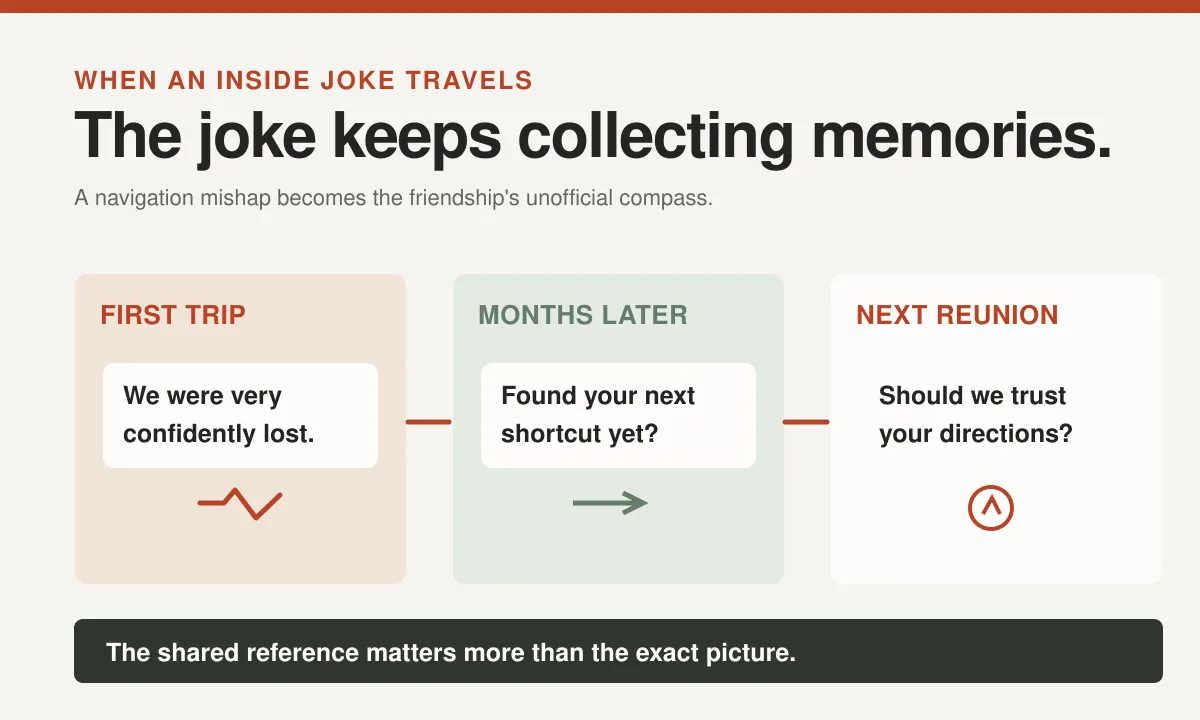
Perhaps you and your friend once got spectacularly lost on a weekend trip. Somebody sent a meme about a confident navigator, and now the picture appears every time either of you mentions directions.
The image has a history. A stranger sees a cartoon map; you remember the wrong exit, the rain and a deeply unhelpful road sign.
Those tiny references can preserve the familiar rhythm of a friendship. You carry on teasing each other about shared experiences even when the next in-person reunion is still some distance away.
Our relatable meme collection is full of everyday situations that become more personal when you recognize the recipient in the caption.
You can also create new inside jokes at a distance. A terrible kitchen experiment, a new hobby or an absurd item in a shop window may become the next recurring reference. Long-distance friendship doesn't have to live entirely on old memories.
Send something that belongs to their day
A generic funny picture can be enjoyable. A picture that connects to your friend's current circumstances usually feels more thoughtful.
If they're preparing for an interview, a cheerful reaction may be welcome. If they're moving apartments, an image about the sheer number of cardboard boxes might give them a laugh. A friend obsessed with coffee will probably appreciate the right morning coffee meme.
Pay attention to their interests instead of forwarding every picture that makes you smile. Your friend should be able to recognize why you chose that specific joke.
A short personal line helps: "Thought of you when I saw this," or "This is you trying to assemble furniture." The second option may start an argument about a bookshelf, which can be a perfectly healthy long-distance tradition.
| Moment | A thoughtful visual message | A helpful follow-up |
|---|---|---|
| New job or interview | An encouraging reaction linked to an inside joke | Ask how it went later |
| A frustrating commute | A relatable, gentle picture | Let them vent if they want to |
| A shared hobby | A specific meme about their interest | Send the article or idea that prompted it |
| A difficult week | A low-pressure check-in | Offer a call or practical help |
Make room for more than jokes
A meme is a lovely low-pressure greeting, but friendship also involves listening, remembering important events and offering help where possible.
When someone shares difficult news, respond to what they are saying. They might appreciate a funny distraction later, especially if they've asked for one. They might prefer a voice call or a straightforward conversation first.
Research on friendship offers a reminder that contact quality matters. An interview with a friendship researcher published by UC Berkeley's Greater Good Science Center discusses the importance of showing up, being helpful and making time for friends, including virtually.
That doesn't mean every exchange must become profound. You can spend one evening talking seriously and another sending pictures of pigeons who seem to be running late for important meetings.
The variety makes a friendship feel like a continuing relationship with a real person, whose life contains serious problems and ridiculous grocery-store encounters.
Respect time zones and reply habits
Your afternoon may be their middle of the night. A string of animated reactions might be delightful on your side of the world and remarkably unpopular beside their pillow.
Check how they prefer to communicate. Some friends enjoy a stream of funny posts they can review later. Others prefer an occasional picture and a proper catch-up. Notification settings can help, but courtesy remains useful.
Avoid demanding an immediate response. A forwarded meme is an invitation, and the recipient is allowed to be busy. The absence of a reaction doesn't require a second image with an even more desperate expression.
If a conversation is important, say so clearly. "Could we talk this weekend?" is more effective than sending increasingly concerned cartoon faces and hoping your friend guesses the topic.
For advice on matching humor to the moment, read how to choose a sweet reaction over a sarcastic one.
Build a little shared routine
Some friends exchange one funny picture every Friday. Others send a reaction after watching the same television show, even from different cities. A simple recurring habit gives you a point of contact that doesn't require constant planning.
You could save a small collection of images about shared interests. A friend who loves birds may appreciate a new bird meme. A group that always jokes about school memories might enjoy an occasional photograph from an old trip, with permission from everyone pictured.
The routine should stay flexible. A busy week, new baby or major deadline may interrupt it. Friendship does not become less real because someone temporarily has fewer opportunities to send a cartoon duck.
You can also mix in voice notes, video calls, letters and visits. Digital jokes fit comfortably beside those ways of staying connected.
There is also a useful difference between checking in and checking up. A joke that says "This reminded me of you" offers a small connection. Sending ten increasingly urgent images because someone hasn't answered can make contact feel like an obligation. If your friend has gone quiet and you are concerned, a direct, considerate question is a better approach.
Another practical idea is to keep the shared jokes organized. Save a few favorites in a private album or conversation thread so you can revisit them without endlessly forwarding old material. If a picture involves somebody else's personal information, keep it within the audience who originally received it.
The goal is a friendly rhythm that fits both lives. The arrangement might change when one friend switches jobs, moves again or becomes a parent. A relationship has room for these changes, and a meme routine can change with it.
Make the next reunion part of the story
When you finally meet again, the accumulated pictures can become a conversation of their own. You may refer to the raccoon meme from February, the infamous bookshelf and the increasingly elaborate jokes about your friend's coffee machine.
Those references help connect the ordinary lives you've been living separately. You already know a little about the details that made each other laugh.
A funny picture cannot replace everything about being together. It can make the space between visits feel warmer, more familiar and rather better stocked with expressive animals.
The next time an image reminds you of a friend who lives far away, send it with a genuine note. The cartoon character may be dramatic, but the gesture can be pleasantly simple. Somewhere in another time zone, a person who knows you well may be about to smile at the same ridiculous pigeon.