
How to Check Whether an Image Is Safe to Reuse
Check image copyright, licenses, permissions, attribution and privacy before reusing an online picture or turning it into a meme.
You have discovered the perfect photograph for a meme. The person in it looks as though they have just learned the coffee machine is on vacation. The image is publicly visible, easily downloaded and accompanied by a comment saying "Use this everywhere." The only missing detail is whether anyone making that suggestion actually owns the picture.
Checking image reuse rights is less glamorous than choosing the caption, but it helps prevent takedowns, disputes and embarrassing conversations with people whose work you didn't have permission to copy.
Publicly visible does not mean freely reusable
Search engines, social platforms and public websites display an enormous number of images. That visibility doesn't automatically transfer copyright to everyone who sees them.
The UK Intellectual Property Office guidance on digital images explains that online images are generally protected unless permission, an appropriate license, expiry of copyright or a legal exception allows the intended use.
The key phrase is your intended use. Sharing a link to a creator's public post is different from downloading the picture, adding text and hosting the edited version on your own website.
A meme template may appear on thousands of accounts while its underlying photograph remains owned by a creator or rights holder. Popularity is evidence of popularity, not evidence of permission.
Find the original source before the reuse terms
Begin by looking for the earliest reliable version of the picture and the person or organization that published it. A repost with a giant watermark may be several steps removed from the creator.
Search by the image itself, key visual details and any visible credit. Reverse-image tools can help locate matching or similar copies, but a result near the top isn't necessarily the original.
Check a creator's website, portfolio or the page on which the picture first appeared. Note the title, uploader, date, license and any specific usage conditions.
Our guide to finding an image's creator sets out a more detailed research process.
If you cannot identify the rights holder, treat that uncertainty as unresolved. "Nobody answered my search" is not the same as "The picture belongs to everybody."
Check the license, not just the label
A picture may be offered under Creative Commons terms, through a paid stock license, with direct written permission or under another agreement.
Read the exact license. Some Creative Commons licenses permit commercial reuse and adaptation with conditions. Others restrict commercial use or the creation of adaptations. Adding a meme caption may count as an adaptation, depending on the original material and the nature of the change.
The Creative Commons reuse guide explains the different license requirements and recommended attribution practices.
A generic "free to use" label without a source or terms is not enough to confirm a commercial reuse right. Follow the link to the original license text and check whether the person offering the image has authority to license it.
Keep a dated note or screenshot of the permission terms. License information and web pages can change, and a useful record makes later review easier.
Understand the main reuse situations
A quick comparison can help you identify the next step.
- Your own original photograph: Check ownership, contracts, recognizable people and protected material pictured.
- Creative Commons image: Check the exact license, required credit, commercial restrictions and adaptation rules.
- Stock-library image: Review the purchased or free license, platform conditions and permitted distribution.
- Public-domain work: Verify the public-domain status and consider the jurisdiction where you plan to use it.
- Random social media repost: Trace the original creator and obtain permission or confirm an applicable exception.
No single category automatically clears every possible issue. Even a properly licensed image may raise questions about privacy, trademarks or other material shown in the photograph.
If the image will support a commercial site, verify that commercial use is covered. A noncommercial license may not fit the intended purpose.
| Where the image came from | What to verify | Typical uncertainty |
|---|---|---|
| Your own photo | Ownership, contracts and people pictured | Protected artwork or recognizable people |
| Creative Commons | Exact license, adaptations and commercial use | NC or ND terms may limit your plan |
| Stock library | License scope and distribution rules | Editorial-only or restricted use |
| Unattributed repost | Original creator and authorization | A repost is not proof of permission |
Give credit, but don't mistake it for permission
Attribution is important when a license requires it, and it is often a considerate practice even when not mandatory.
But writing "Credit to the owner" does not make unauthorized copying lawful. Neither does placing the creator's social handle below the picture.
For many Creative Commons works, the suggested attribution framework is TASL: title, author, source and license. The Creative Commons guidance explains how to include those details and note modifications.
If permission is required, get it before publishing. Ask about the specific use: editing, uploading, distribution, advertising, printing or other plans relevant to the project.
Keep the response somewhere accessible to the team. Six months later, nobody should have to search an old message thread to prove the cartoon penguin was properly licensed.
Fair use and exceptions require care
Some uses of copyrighted images may fall under exceptions such as fair use in the United States or fair dealing and other permitted acts in the United Kingdom. These are not blanket permissions for anything labeled a meme.
The US Copyright Office fair use index describes a case-specific assessment involving purpose, nature of the work, amount used and market effect. A funny caption alone doesn't guarantee the result.
UK rules differ, and the Intellectual Property Office copyright guidance explains that reuse needs permission, an applicable license or a relevant exception.
Commercial intent, the amount copied, transformation and context can all matter. The answer may require qualified legal advice when the use is important or disputed.
Do not turn a legally uncertain image into a "safe" one simply by cropping it or changing the colors. A new filter cannot sign a license agreement.
Check the people in the image
Copyright is only part of the story. A photograph may show a recognizable person, a child or someone in a private setting.
Think about consent, privacy and how the meme changes the impression of the person pictured. Adding a caption that suggests misconduct or an embarrassing situation can create problems even when you took the photograph yourself.
If the content is sensitive or the person is uncomfortable, choose another image. A staged picture of your own expression or an original drawing can communicate the same reaction.
Be particularly careful with private messages, medical details, addresses, workplace documents and other information visible in the background.
Our guide to making funny visuals without somebody else's face offers lower-risk creative alternatives.
Make a practical pre-publication checklist
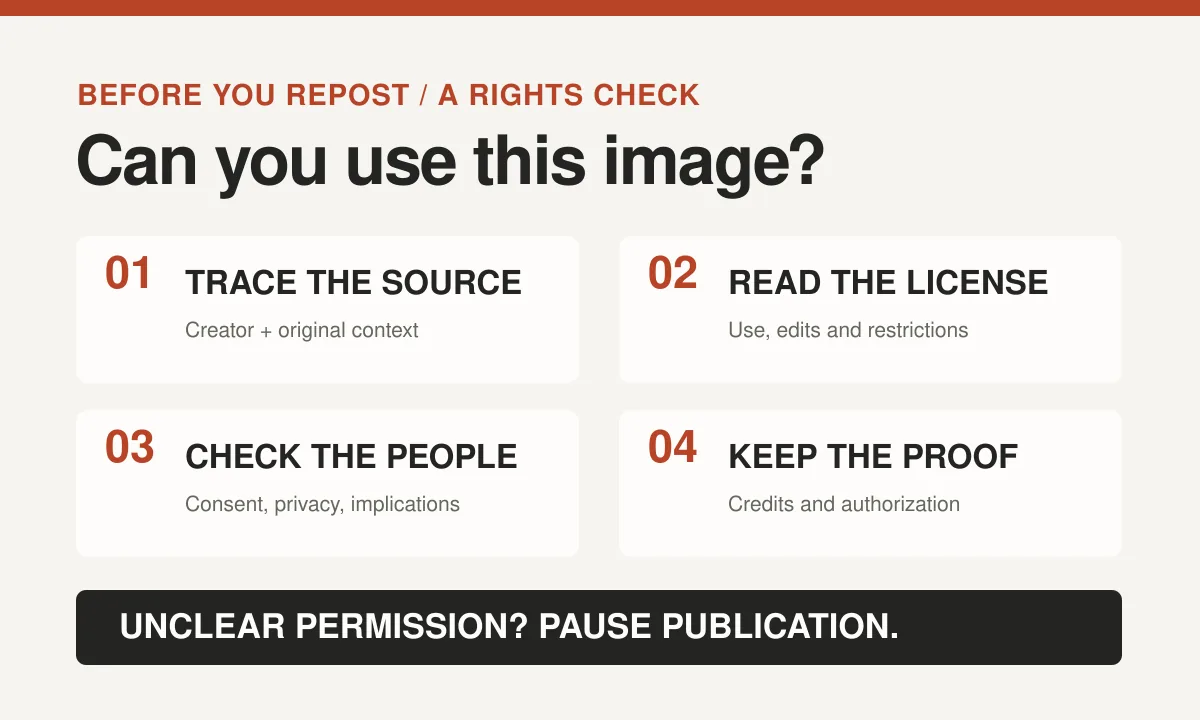
Before uploading, verify:
- Creator: Have you identified who made the image or who controls the relevant rights?
- Source: Can you point to a credible original page rather than only a repost?
- Permission: Does a license, direct agreement or applicable exception cover this specific use?
- Changes: Can you crop, add text and publish the altered version under those terms?
- Attribution: Have you supplied any credit, license link and change notice required?
- People: Are consent, privacy and misleading implications addressed?
- Records: Have you saved evidence of the terms or permission?
- Alternatives: Could an original photo, drawing or licensed asset achieve the same joke?
When the answer remains uncertain, pause that image and keep searching. The internet has many expressive chairs waiting for a caption.
What to do when a rights holder responds
If you contact someone about reuse and receive permission, keep a record of exactly what they authorized. A yes to one social post may not cover commercial advertising, merchandise or an altered version of the photograph.
If they decline, choose another image. If they ask for conditions such as a link, credit or a limit on where the asset appears, review those conditions before proceeding.
Respecting a refusal is much easier than turning a small joke into a long dispute about what you thought their message meant.
A safer creative route is often simpler
Original photographs of objects, commissioned illustrations with clear rights, or properly licensed assets can be easier to manage than a mysterious viral picture.
A license does not automatically solve every question, and your own photo may still include someone else's protected work. But you can reduce avoidable uncertainty by choosing material you can account for.
Majestic Memes also has an image-rights and credits information page explaining the site's approach to this subject.
The best meme should make readers laugh, not require your team to spend Friday afternoon reconstructing the provenance of a hamster photograph. Clear rights are a better punchline than an unexpected legal letter.