
How to Create Funny Visuals Without Using Someone Else's Face
Create original funny images using objects, typography, drawings and staged photos without relying on strangers' faces or unclear rights.
Not every funny picture needs a celebrity looking astonished, a stranger caught mid-sneeze or a screenshot of somebody who never agreed to become the internet's official representative of mild disappointment.
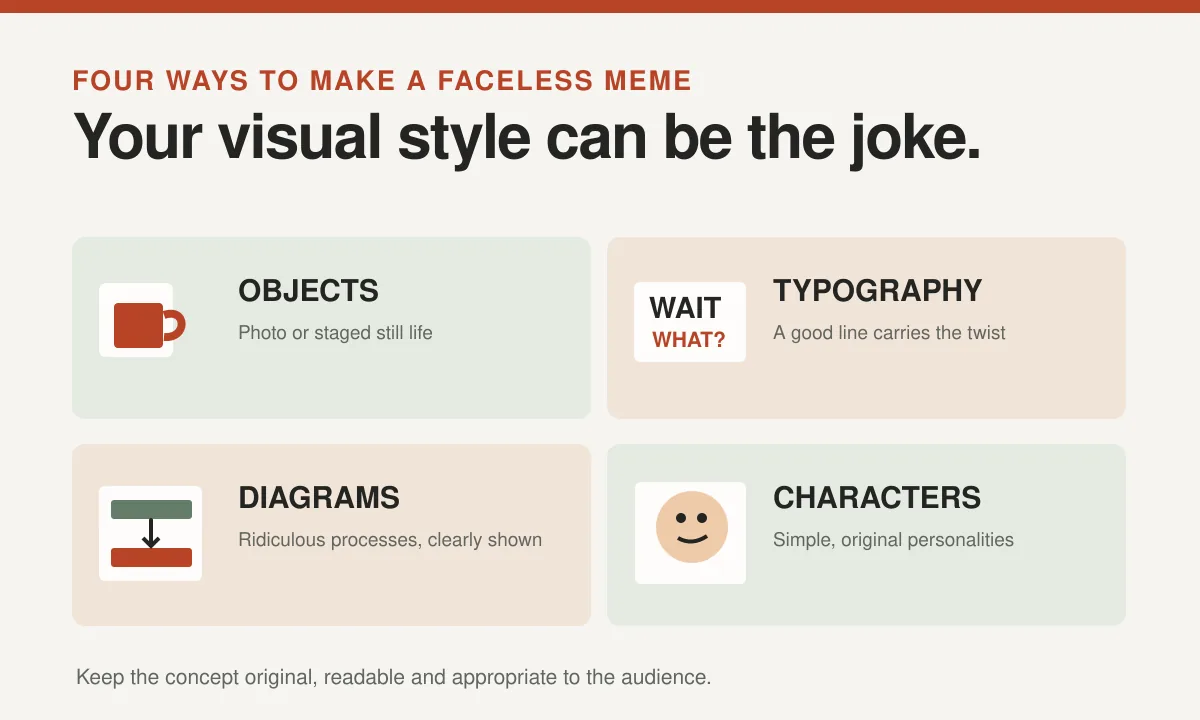
You can make an excellent meme using objects, drawings, typography, pets, symbols and original scenes. In some cases, removing the face entirely makes the joke clearer because viewers spend less time identifying a person and more time recognizing the situation.
Give ordinary objects an unreasonable personality
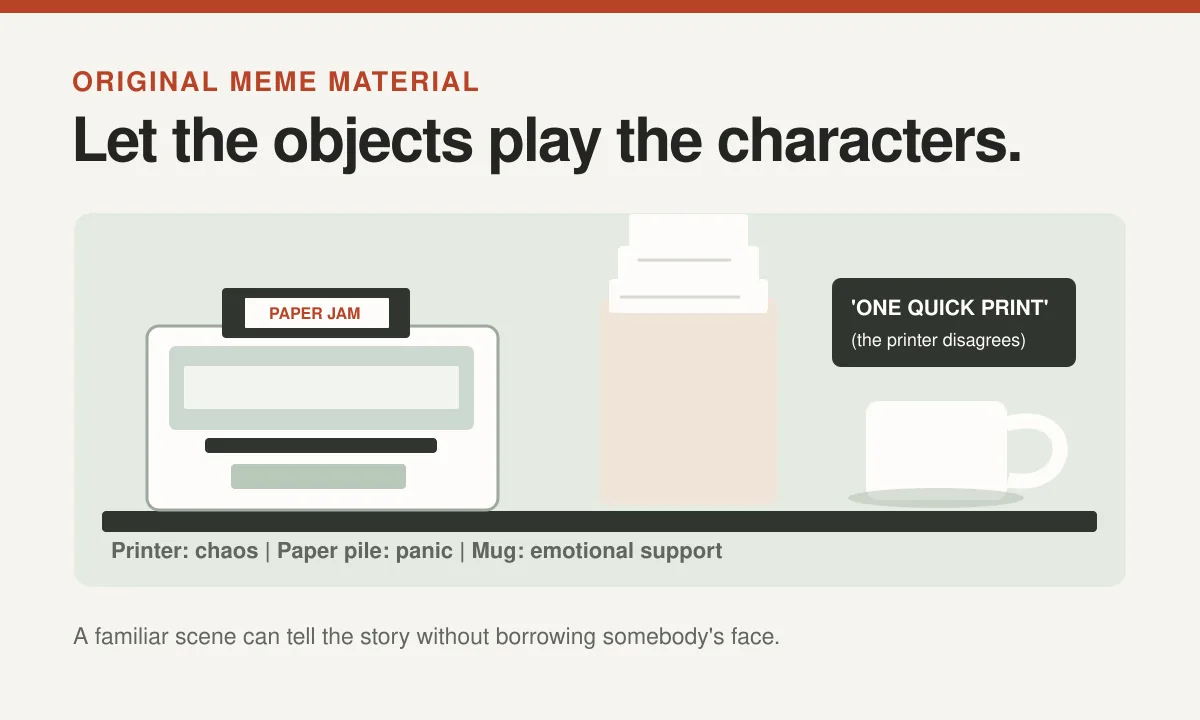
Household objects are gifted performers. A printer with a warning light can represent an uncooperative coworker. A stack of dishes can resemble an ambitious project that has escaped management. A mug left at the edge of a table looks suspiciously ready to begin an argument.
Start with a photograph you took yourself of an object arranged in a clear scene. Think about what feeling the object suggests. A single sock beside a full laundry basket can express a mystery that countless people have encountered.
Add a caption such as "Me preparing to explain why the task isn't finished" to a photograph of a tiny, crooked tower of books. The humor comes from comparing an ordinary item to a familiar human experience.
Our relatable meme collection shows how everyday frustrations can carry a joke without an elaborate backstory.
The subject doesn't need a face. An object can be the straight-faced witness to a very silly situation.
Use hands, gestures and silhouettes
A person's expression is not the only way to communicate emotion. Hands gripping a coffee mug, a dramatic shrug or a silhouette standing before a mountain of boxes can be recognizable visual setups.
You can stage your own gestures, photograph an object from an unusual angle or create a simple illustration. The image might express confusion, relief or exaggerated confidence.
Be careful when photographing someone else, even if their face is hidden. A distinctive tattoo, workplace uniform or location can still make them identifiable. Ask permission when a person is involved.
A silhouette also needs clear context. A shadowy figure may look mysterious without explaining the joke. Pair it with a readable caption or a prop that establishes the situation.
For tips on building the caption, see how to turn a simple photo into a funny image.
Let typography carry the punchline
Sometimes the visual joke is a phrase displayed with deliberate emphasis. A large "I WILL BE PRODUCTIVE TODAY" above a tiny "after one more video" creates a recognizable contrast.
Typography lets you control the setup and the reveal without borrowing anyone's photograph. Use your own wording, a readable typeface and an intentional hierarchy.
You can make two-panel compositions: the plan on the left and the actual result on the right. Or use a mock checklist where every task is sensible until the last item introduces an absurd complication.
Keep the layout simple. A page covered with six font styles and fourteen arrows may technically be a design, but it is also a very effective way to frighten the human eye.
Make sure important text remains accessible as actual text when possible. If the words exist only inside an image, provide a meaningful alternative description.
Draw a deliberately simple character
You do not need professional illustration skills to make an original reaction. A rounded shape with two dots for eyes, a slumped posture and a small coffee cup can convey exhaustion. A crooked triangle wearing a tie can look disturbingly familiar to anyone who has attended an early meeting.
Simple characters are useful because you can change their posture, expression and props for different situations. They also give your project a consistent visual style.
Avoid copying a famous character's distinctive appearance too closely. Creating a new illustration is a better way to build something you control than tracing an existing cartoon and calling the result original.
Even a badly drawn original character can become a running joke. If it is intentionally simple and the caption is good, the awkwardness may help.
Our guide to why old meme formats return considers how a recognizable visual structure can support new jokes.
Build humor from charts and diagrams
A mock flowchart can turn an ordinary decision into an unnecessarily complicated process. "Should I leave the house?" branches into "Do I have my keys?" and "Where are my keys?" before returning to the original question.
A fake progress bar might show a project apparently stuck at 99 percent because the final step requires choosing a file name.
The humor comes from treating a familiar frustration as though it needed formal analysis. Use clear labels, simple shapes and enough whitespace for a reader to follow the sequence.
Don't present invented numbers as factual research. If the graphic is a joke, make the playful framing clear. A parody chart about the emotional stages of assembling furniture shouldn't be mistaken for an actual survey.
Use original icons and shapes, or assets whose licenses cover your intended purpose. A diagram can avoid human faces while still containing copyrighted illustrations.
Take your own staged photos
Staging a silly scene gives you control over composition and permission. Arrange several mugs to look like an important meeting. Put a calculator beside a mountain of crumpled notes. Place a toy dinosaur in a queue behind a houseplant.
Shoot from an angle that makes the visual relationship obvious. The joke usually needs a clear setup and one surprising detail, not a studio full of props.
Before posting, remove private documents, address labels and sensitive information visible in the background. A calendar on a desk can expose more than its owner intended.
If other people or their belongings appear, check consent and relevant rights. Original photography is a useful starting point but not an automatic clearance for everything included in the scene.
Our guide to turning your own photos into memes covers the practical editing steps.
Check what you actually own
Even when an image contains no recognizable face, copyright questions remain. A photograph of a protected artwork, a screenshot of a film or a recognizable branded character may still involve somebody else's rights.
The UK Intellectual Property Office guidance on digital photographs explains why ownership, contracts and underlying material can affect reuse.
For a public site or commercial project, choose original drawings, your own compositions or properly licensed assets whenever feasible. If you use someone else's artwork, check the exact permission or license before editing it.
Our image reuse checklist helps distinguish ownership from attribution and other permission questions.
Avoid assuming that a filter, crop or new caption erases existing rights. The picture may be funnier, but the copyright doesn't disappear in a puff of comic smoke.
| Visual approach | Why it works | Rights and privacy check |
|---|---|---|
| Own object photograph | A familiar scene becomes the joke | Look for private documents or protected artwork |
| Original typography | The contrast between phrases carries humor | Use fonts and graphic assets under suitable licenses |
| Custom flowchart | Ordinary choices become absurd processes | Label parody values clearly |
| Original character drawing | A repeatable expression becomes recognizable | Avoid copying a protected character design |
Write alt text for the visual joke
Faceless memes still need thoughtful accessibility when they convey meaningful content. A picture of three mugs arranged like a meeting with a caption about Monday morning can be described without inventing human expressions.
For example: "Three coffee mugs sit around a tiny paper agenda; caption reads 'The team meeting before everyone has had coffee.'"
The W3C image tutorial recommends alternatives that communicate an image's information or function. Pure decoration may need empty alt text, while a joke carried by the image benefits from an accurate description.
Our alt text guide for funny images offers examples for captions, reactions and animations.
Test the description by imagining someone hearing it without seeing the picture. They should understand the scene and why the caption belongs to it.
Originality can become your signature
Using your own objects, drawings and simple layouts gives the project a recognizable visual voice. A recurring cartoon office chair might become the mascot of bad scheduling decisions. A little paper boat can represent unreasonable optimism in every weather-related joke.
You can refine the characters and templates over time without depending on the next viral photograph. Your library also becomes easier to manage when you know where the source material came from.
The next time you need an expression of disbelief, you don't have to locate a stranger's face. Photograph a wilted houseplant beside an empty watering can. Add a good caption. The plant has already delivered a compelling performance, and nobody has been volunteered for internet fame without asking.