
Turning an Awkward Moment Into a Great Punchline
Learn how to turn embarrassing everyday moments into funny stories and memes, with sharp details, thoughtful timing and kind punchlines.
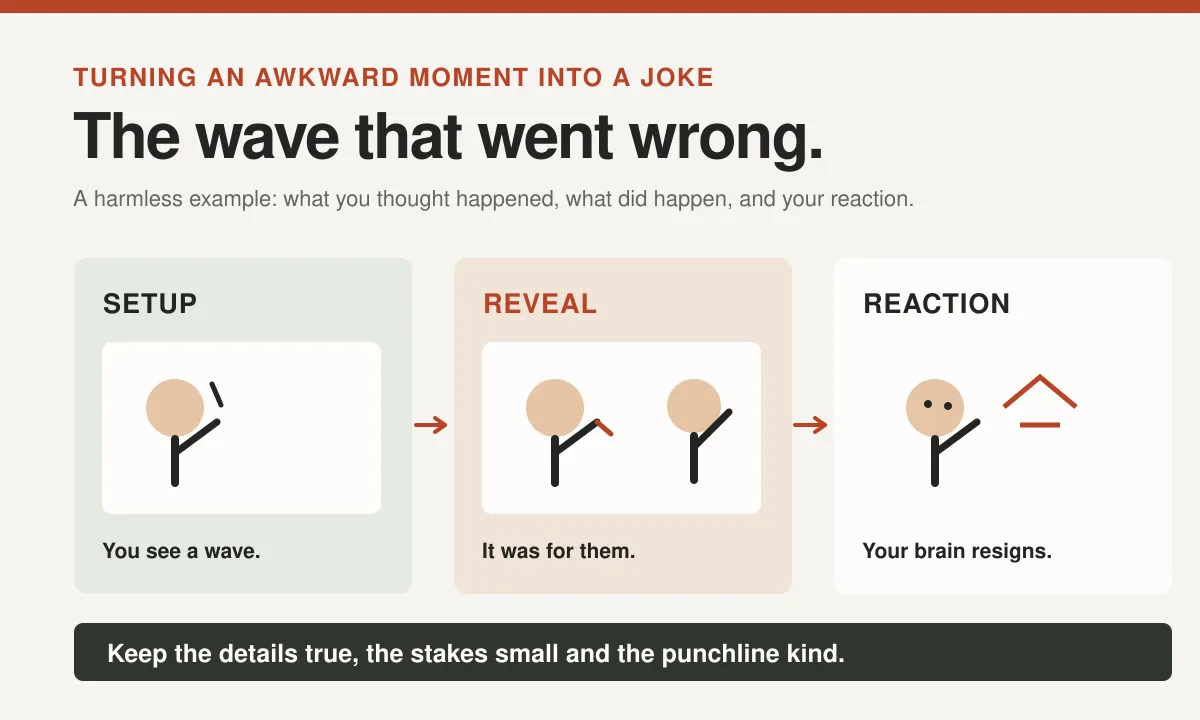
You wave enthusiastically at someone across the street. They look confused. You realize they were waving at the person standing directly behind you, who has now witnessed your entire performance. For one ghastly second, moving to another country seems reasonable. Later, you tell the story and everyone laughs, including you.
That journey from embarrassment to comedy is where many relatable jokes begin. An awkward moment supplies a recognizable situation, a little tension and an ending you never planned. The trick is choosing the details that make the story funny without using somebody else's discomfort as the entertainment.
Give the moment enough distance
Trying to turn an embarrassment into a joke while it is happening can feel like asking a toaster to perform open-heart surgery. You're busy processing the situation. Your ears may also be doing that wonderful thing where they become noticeably warmer.
A little time can change how you see it. You discover that nothing serious happened, the other person has probably forgotten it and the incident has a wonderfully ridiculous shape. The failed handshake becomes a story about two people attempting an improvised dance.
Start by asking whether you can laugh about it comfortably. If the answer is yes, you may have good material. If the incident involved harm, a private disclosure or somebody being genuinely upset, it deserves more care than a punchline.
The relatable meme archive works with these low-stakes stumbles. Familiar everyday errors become funny when an image captures the expression you wish nobody had seen.
Find the detail that makes the story yours
"I said something embarrassing" could describe half of human history. "I told the cashier 'You too' after they said 'Enjoy your meal'" gives your audience a precise little scene.
Specificity helps people picture the moment. Where were you? What were you trying to do? Which tiny mistake turned a perfectly ordinary interaction into a performance?
Don't include every detail. Your audience probably doesn't need the weather, your route to the restaurant or a complete inventory of your pockets. Choose the fact that creates the absurdity. Perhaps you were carrying a birthday cake while confidently entering the wrong party. The cake matters. The brand of your shoes probably doesn't.
A good caption can often do the job: "Me walking into the meeting room after confidently announcing the wrong department." Add a bewildered reaction image and the story becomes portable.
Build toward the moment everything changed
A funny story usually needs a normal expectation before the surprise. You thought a stranger was greeting you. You thought the door opened automatically. You thought the video call was finished when you made an expressive comment about the meeting.
Give the audience that ordinary starting point, then reveal what went wrong. The comedy comes from the contrast between the reasonable plan and the unexpected outcome.
Try telling the story in a couple of sentences: "I thanked the voice assistant for opening the blinds. A person on the call said 'You're welcome.' I hadn't realized my microphone was on." The final detail changes how we understand the earlier one.
Avoid forcing a punchline with an unrelated last sentence. If the moment was inherently funny, let the actual event carry it. Readers are more likely to enjoy a sharply observed mishap than a long explanation about why they should be laughing.
Exaggerate your reaction, keep the facts recognizable
A meme can make the feeling much larger than the event. The moment you enter the wrong classroom becomes a picture of a ship captain discovering an iceberg. The scale is ridiculous, and everybody understands the exaggeration.
That doesn't require inventing what somebody else said or did. You can make your own internal panic theatrical while describing the real situation accurately. "My brain filed an urgent resignation letter" is clearly comic language; claiming a stranger publicly insulted you when they didn't is a different matter.
Visual humor is particularly useful here. A dramatic face captures the sensation of realizing you have made a tiny social error, without demanding a paragraph about your emotional condition.
Our article on why reaction images can say more than a paragraph explains how familiar expressions communicate that exaggerated feeling quickly.
Keep the joke aimed at the right person
Your own minor mistakes are usually safer material than somebody else's. If a friend accidentally calls a teacher "Mom," they may laugh about it later. They may also wish to retire the incident permanently. Let them decide.
Avoid sharing private screenshots, photographs or details that could identify someone who hasn't agreed to the story. This matters especially in workplace chats, school groups and large family threads where a casual joke can escape its original context.
Even when you're the main character, consider whether another person becomes the unwilling punchline. A tale about accidentally waving at a stranger needs no speculation about the stranger's appearance, background or intelligence.
For a more careful look at an audience, see how to read the room before sharing something funny. The setting can change how the same harmless story is received.
Turn it into a meme people can actually understand
Once you've identified the funny beat, choose a picture that supports it. You want the viewer to recognize the emotion immediately: misplaced confidence, sudden panic, polite confusion or a defeated attempt at dignity.
A simple format often works best:
- Name the ordinary intention: "Me confidently walking into the right meeting."
- Reveal the unexpected detail: "The meeting is about an entirely different project."
- Pair it with an expression that shows how that realization felt.
Keep the text readable on a phone. If the picture needs a magnifying glass and a six-slide presentation, it has probably become another awkward moment.
You can also tell the story without a meme. A concise anecdote spoken to a friend may be funnier because the timing and your expression do the work. The format should suit the audience, not the other way around.
A useful test is to tell the short version to one trusted friend first. If they ask a question, the missing detail may help the story. If they laugh before you reach the end, you've probably identified the part worth keeping. If their expression suggests concern, reconsider whether the incident is ready to become comedy. A friendly rehearsal beats publishing the first draft to an audience of hundreds.
| Moment | Generic description | More specific comic setup |
|---|---|---|
| Waving at a stranger | That was embarrassing | Me waving confidently before realizing they meant the person behind me |
| Entering the wrong meeting | I got confused | Me presenting my plan to a room discussing an entirely different project |
| Replying automatically | I said the wrong thing | Me saying 'You too' when the cashier says 'Enjoy your meal' |
Know when to stop revisiting the incident
A joke that produces a warm laugh once doesn't necessarily improve after the sixth retelling. If the person involved looks uncomfortable or the group has moved on, let the moment rest.
Some experiences become genuinely funny stories over time. Others remain annoying or personal. Nobody owes the audience a cheerful response simply because the storyteller found a good caption.
The reward is being able to look at a small, embarrassing episode and recognize how absurd ordinary life can be. Tomorrow you'll probably press the wrong elevator button or enthusiastically thank a self-service checkout. You have several options. One is to pretend it never happened. Another is to keep a very expressive cat picture ready.