
Better Captions: How to Make a Simple Photo Funny
Make everyday photos funnier with relatable situations, well-timed punchlines, readable meme captions and specific observations.
A photograph of a chair is usually just a photograph of a chair. Give it the caption "Me pretending to be available while my brain has already gone home," and the chair begins to acquire a remarkably convincing office personality.
A good caption doesn't have to announce that the photo is funny. It supplies a situation, changes how we see the image or turns one tiny detail into the entire joke. The best ones feel obvious after you've read them, which is deeply irritating when you've spent forty minutes trying to write one.
Start with what the photo already suggests
Look at the expression, pose, setting or object before writing anything. Is somebody leaning dramatically toward a doorway? Does an animal appear puzzled? Is an ordinary item positioned as though it has just failed an important test?
Describe the immediate visual in simple words. Then ask what everyday experience has the same feeling.
A dog staring at an empty plate might remind you of checking the refrigerator despite knowing exactly what is inside. A tilted stack of boxes can resemble a schedule that was optimistic from the beginning.
The connection matters more than a clever turn of phrase. Our relatable memes work because familiar experiences give the image something recognizable to express.
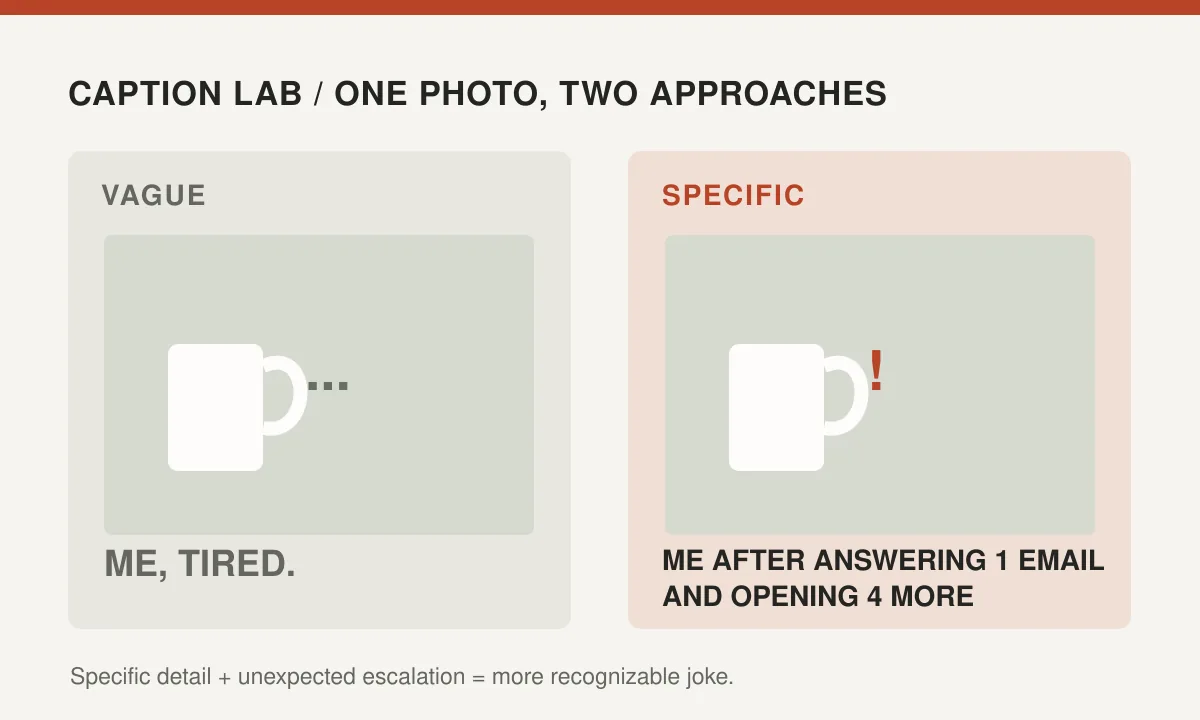
Choose a specific situation over a general mood
"Me being tired" describes an enormous number of possible pictures. "Me after answering one email and discovering four follow-ups" produces a little story.
The second line has a situation, an expectation and a complication. It gives the viewer something concrete to recognize.
Try collecting details from ordinary life: a delayed train, a mysterious phone notification, a group chat arranging dinner or a password reset that asks you to remember a password you obviously cannot remember.
The more specific your setup, the less explanation your photo needs. But specificity should come from an experience that matters to the intended audience, not from stuffing the caption with six obscure references.
Use contrast to create the punchline
Many funny captions work by placing an ordinary problem next to an unexpectedly dramatic image. A solemn statue becomes the face you make when the coffee machine breaks.
The contrast can also work the other way. A triumphant character paired with the caption "When you remember to bring your reusable bag" makes a tiny success feel like a world championship.
Look for the gap between how important the picture looks and how minor the actual situation is. That gap gives the viewer the enjoyable task of connecting the two.
Avoid using serious personal suffering as a surprise punchline. Exaggerating the emotional scale of a late meeting is one thing. Trivializing someone's emergency is another.
Our guide on turning awkward moments into punchlines explores the difference between affectionate exaggeration and jokes that land badly.
Let the last few words do the work
A caption often becomes funnier when the reveal arrives at the end. Consider: "Me confidently joining the call, unaware that the camera was already on." The final detail changes the scene.
Compare that with a caption that begins by explaining the camera mistake, then spends two more sentences describing how embarrassed the character feels. The surprise has already left the room.
Write the setup first, then place the important twist as late as you reasonably can. Read the line aloud to see where the natural pause falls.
Don't force every joke into a rigid formula. A short observation can work perfectly without a surprise ending. The aim is to respect the reader's attention, not to turn a photo of a spoon into a suspense thriller.
Try three different caption angles
When a photograph isn't producing a good line, change the approach rather than adding more words.
- Relatable frustration: "Me refreshing the delivery tracker as if I control the driver's route."
- Tiny victory: "Me leaving the house with my keys, wallet and phone on the first attempt."
- Playful exaggeration: "The toaster after completing one perfectly acceptable slice of bread."
Each angle gives an image a slightly different role. The best fit depends on its expression and the group receiving it.
You can also try a brief exchange. A photo of two animals looking at each other might support a question-and-answer joke, provided the conversation remains easy to follow.
Our article on why a reaction image can say more than a paragraph explains why the visual can carry enough emotion that the text only needs to provide context.
| Angle | Start with | Example |
|---|---|---|
| Everyday frustration | A task that keeps multiplying | One email answered. Four more appeared. |
| Tiny victory | Something almost too small to celebrate | Found my keys before I was late. |
| Absurd exaggeration | A dramatic response to a minor event | The toaster after making one decent slice. |
Keep the text readable on a phone
The joke can be excellent and still fail if nobody can see the caption. Small letters, busy backgrounds and low contrast make images difficult to understand.
Keep words away from the face or object carrying the reaction. Use a clean, readable typeface and check your exported image at the size people are likely to see in a chat.
If you need a long explanation, consider putting that context in the accompanying post rather than cramming it into the photograph.
A single caption with a strong visual beat often works better than an image covered in labels, arrows and miniature paragraphs. Your readers did not open the group chat to sit a comprehension exam about an office chair.
Adjust the joke for your audience
An image that works among close friends may need a clearer caption for a broader audience. An inside joke about "Tuesday's incident" means something to your group and very little to anyone else.
A good test is whether somebody who missed the earlier conversation can understand the basic situation. You can keep the personal reference, but provide enough context for the image to stand on its own.
Use kind humor when the subject is a real person. Mocking someone's mistake may be funny to you and uncomfortable for them. A picture of an object or a staged expression can express the same awkward feeling without turning a stranger into a target.
If you're sending the caption to a mixed group, reading the room matters as much as word choice.
Include a text alternative when the caption is part of the image
A meme with words printed on the picture may not be accessible to someone who cannot view it. Where possible, provide alt text or a description that includes the meaningful scene and the caption.
The W3C guidance on images of text explains why important words inside an image need a text equivalent. The goal is to communicate the joke, not merely announce "funny meme."
For example: "A small dog looks sternly at an empty bowl. Caption: 'Me checking whether dinner has arrived early.'" That is usually more useful than "Dog meme, hilarious, best meme ever."
You can read our complete alt text guide for examples and exceptions.
Edit until the caption sounds effortless
Take out words that explain a feeling the image already shows. A photograph of someone looking shocked rarely needs a sentence saying that they are shocked.
Remove filler before the punchline. Replace abstract phrases with concrete details. Keep the language natural to the people who will read it.
Once you've got a clear line, step away for a moment and read it again. Does the picture still make sense? Is the tone friendly? Is the joke genuinely about the situation you had in mind?
You can test two versions with a friend without turning the exchange into a formal research project. The strongest captions let a simple image become familiar to somebody else. You supply one precise observation, and the reader brings their own memory. The chair has now been promoted from furniture to official spokesperson for a difficult workday.