
Why Timing Can Make or Break a Joke
Discover how punchline timing, pauses and group-chat context affect whether a reaction meme feels perfectly funny or awkward.
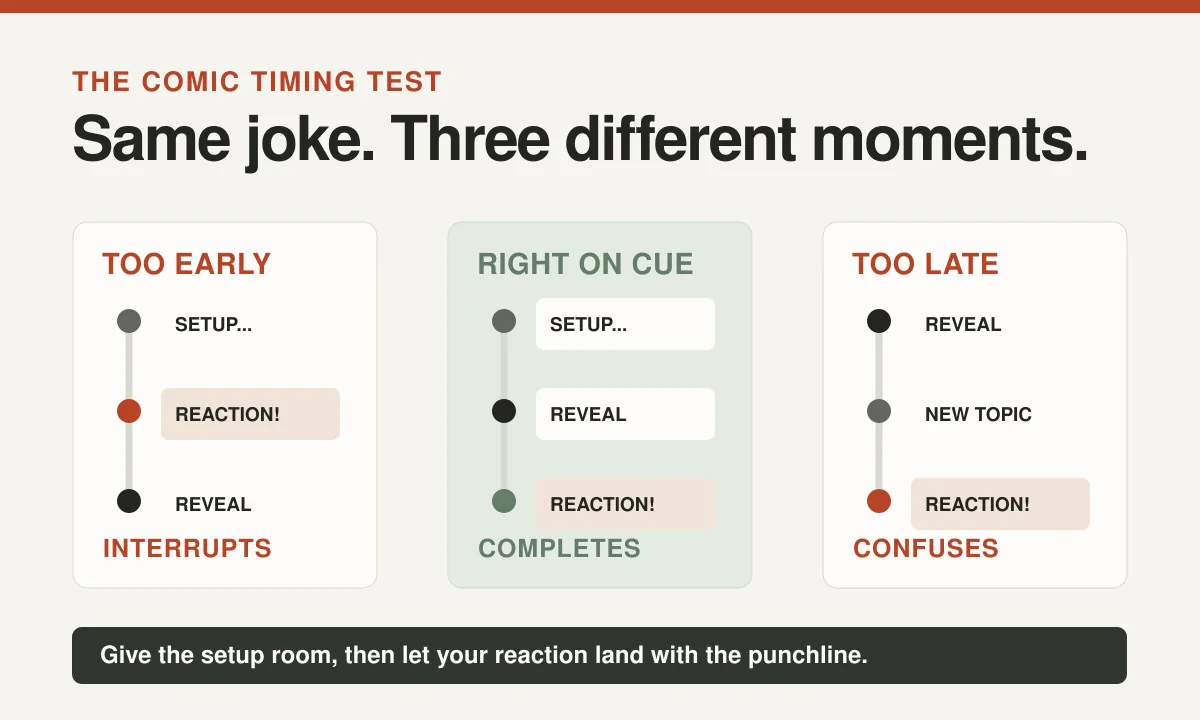
A friend is telling a story about accidentally joining the wrong video meeting. You have the perfect reaction image ready: a character staring at the screen with the expression of somebody who has just discovered a new law of physics. You send it before the friend reaches the ending. The group laughs at your picture, then misses the actual punchline.
Timing can make an ordinary joke memorable or turn an excellent one into an interruption. It affects surprise, rhythm and the social message a person receives when humor appears.
A joke needs room for the surprise
Many jokes establish an ordinary expectation and then change it. You imagine a routine event, only to learn that something slightly ridiculous happened.
If the punchline arrives too early, the listener may not understand the setup. If it arrives after a lengthy explanation, the sense of surprise can fade.
A short pause creates space. You tell your friend, "I entered the room confidently..." and let them imagine a normal entrance before adding, "...then realized I was in somebody else's birthday party."
The idea isn't to perform every joke with dramatic theatrical silence. It is to let the essential detail arrive when the audience can recognize what has changed.
Our guide to turning an awkward moment into a punchline uses this principle with everyday mishaps.
Conversations have rhythms of their own
A lively group chat might exchange pictures and short messages in rapid succession. A one-to-one conversation about an important decision usually moves more slowly.
When you join, follow the existing rhythm. If people are already swapping playful reactions, one more may fit. If someone is trying to explain a difficult problem, a joke can feel like a refusal to listen.
You don't need to map every interaction with a stopwatch. Look at the recent messages. Is a question unanswered? Is someone celebrating? Has the group moved on from the funny subject?
The group-chat etiquette guide explains why the right joke at the wrong moment can still produce an awkward silence.
Timing is not just a technical property of comedy. It is a way of showing that you're paying attention.
Give an image its own beat
Reaction memes are especially sensitive to timing because they often function as a reply rather than a full story.
Imagine a friend revealing that they spent forty minutes looking for a phone they were holding. A shocked expression immediately after that line may be delightful.
Send the same image while they are still describing the search, and you may interrupt a better ending. Send it an hour after the conversation has changed topic, and it might look like an unexplained medical update from a cartoon character.
A reaction image works best when it belongs to the most recent relevant message. Our article on why reaction images can say more than a paragraph looks at the emotional shorthand behind those quick replies.
If your friend is typing, consider letting them finish. The meme will survive another eight seconds.
Know when the silence is useful
A small pause can improve a punchline. It gives people time to picture the ordinary situation before the surprising detail arrives.
But silence after a joke is not always a request for another one. Someone may be considering a reply, busy with something else or simply uninterested.
The temptation to follow an unanswered joke with three increasingly elaborate alternatives is understandable. It is also an efficient way to make the original moment less funny.
Let conversations breathe. If a joke misses, return to the subject or acknowledge the awkwardness lightly. You don't need to defend the punchline as though the group chat were a courtroom.
A confident silence is often better than an explanation beginning, "What makes this funny is..."
Sensitive moments change the rules
A person telling you about an illness, a loss or a serious problem may not want a humorous response, even if the joke seems clever.
Some people use humor when coping with difficult experiences. That preference can be important, but you should follow their lead rather than assume everybody appreciates the same kind of distraction.
Ask what they need when you're unsure. "Do you want a distraction, or would you rather talk?" gives the other person control.
Our article on reading the room before sharing something funny is a useful companion to timing. The moment matters, but so does the person.
A sincere acknowledgment can be the best response, especially when somebody needs practical support.
| Conversation | Better timing | What to avoid |
|---|---|---|
| A funny story in progress | Wait for the last detail | Interrupting with the reaction |
| Someone sharing a success | Congratulate them first | Sarcasm that obscures support |
| A serious personal disclosure | Listen and follow their lead | An uninvited joke as a distraction |
| A busy group discussion | Wait for an appropriate pause | Flooding the chat with old reactions |
Seasonal timing adds another layer
Some jokes are funniest when everyone is living through the same situation. A caption about a forgotten gift is especially recognizable during a busy holiday season. A joke about checking the alarm clock may land at 7:30 on a Monday.
The audience brings a current experience to the punchline. A familiar ritual becomes part of the setup without you having to explain it.
But seasonal jokes can become stale when the occasion passes. The photo of a heroic person wrestling with wrapping paper may lose some charm in the middle of summer.
For more on that shared context, read why holiday humor feels different.
A joke doesn't have a strict expiration date, but relevance helps. So does an audience who remembers why you saved the image in the first place.
Repetition changes the effect
A recurring joke can improve with familiarity when people enjoy the tradition. A family member may send the same exasperated cat every time somebody suggests a particularly complicated dinner plan.
Eventually the image becomes a shared reference. The timing itself may be part of the joke because everyone is waiting for the familiar reaction.
The same repetition can become exhausting if it arrives at every opportunity. A joke stops feeling spontaneous when people can predict the entire exchange before the conversation begins.
Watch for engagement. If people add fresh variations, the joke may still be enjoyable. If they're trying to discuss something else, let the running bit retire temporarily.
A few ways to improve your comic timing
You can practice without turning your next family dinner into a rehearsal for a one-person show.
- Identify the ordinary setup before revealing the surprising detail.
- Keep the explanation short enough that the moment stays fresh.
- Give people room to finish their stories before replying with a meme.
- Match the emotional tone of the conversation.
- Avoid sending a second joke solely to rescue the first.
- Notice when the group has moved to a new subject.
These are helpful habits, not rigid scientific rules. Different groups enjoy different pacing, and a spontaneous interruption can sometimes be funny when everyone clearly welcomes it.
The point is to create a shared moment rather than demand an audience.
One useful habit is to reread the message you're answering immediately before sending the image. It takes a moment and can catch the classic error of replying to a joke after the conversation has become serious.
The joke should belong to the moment
Good comic timing is part surprise and part consideration. You understand what the other person is saying, recognize a fitting connection and let the joke arrive without pushing aside the conversation.
You can have the best photo, caption and reaction GIF on the internet. None of them can guarantee laughter if the moment isn't right.
If you miss it, don't worry. There will be another chance to send the bewildered character. Your friends will continue making inexplicable decisions involving video meetings, and the internet has a remarkable supply of appropriate facial expressions.