
Why Holiday Jokes Feel Different From Everyday Humor
Discover why holiday memes feel especially relatable, from recurring family traditions and seasonal mishaps to shared celebrations.
On an ordinary Tuesday, a photo of somebody struggling to assemble a chair is a mild joke about furniture. During the holidays, add a crooked decoration and a relative insisting the instructions are wrong, and suddenly everybody in the family chat has a story.
Holiday humor feels distinctive because the calendar brings familiar rituals, expectations and repeated characters into the same conversation. People recognize the annual scramble, the special food and the strange confidence with which an entire household approaches a task nobody enjoyed last year.
Familiar traditions provide the setup
A joke lands quickly when the audience already knows the situation. Holiday meals, decorations, travel plans and family gatherings carry recognizable patterns.
You don't need to explain why a photograph of a chaotic kitchen might be funny shortly before a large celebration. Many people have watched a carefully planned menu develop an independent personality.
The strongest captions focus on a specific detail. "Us checking whether the potatoes are done for the seventh time" is more vivid than a generic claim that holidays are stressful.
You can find examples of seasonal humor in the Easter meme collection, where familiar holiday symbols take on surprisingly expressive roles.
Remember that traditions differ between families and cultures. A joke about a particular custom may delight one group and require a little context for another.
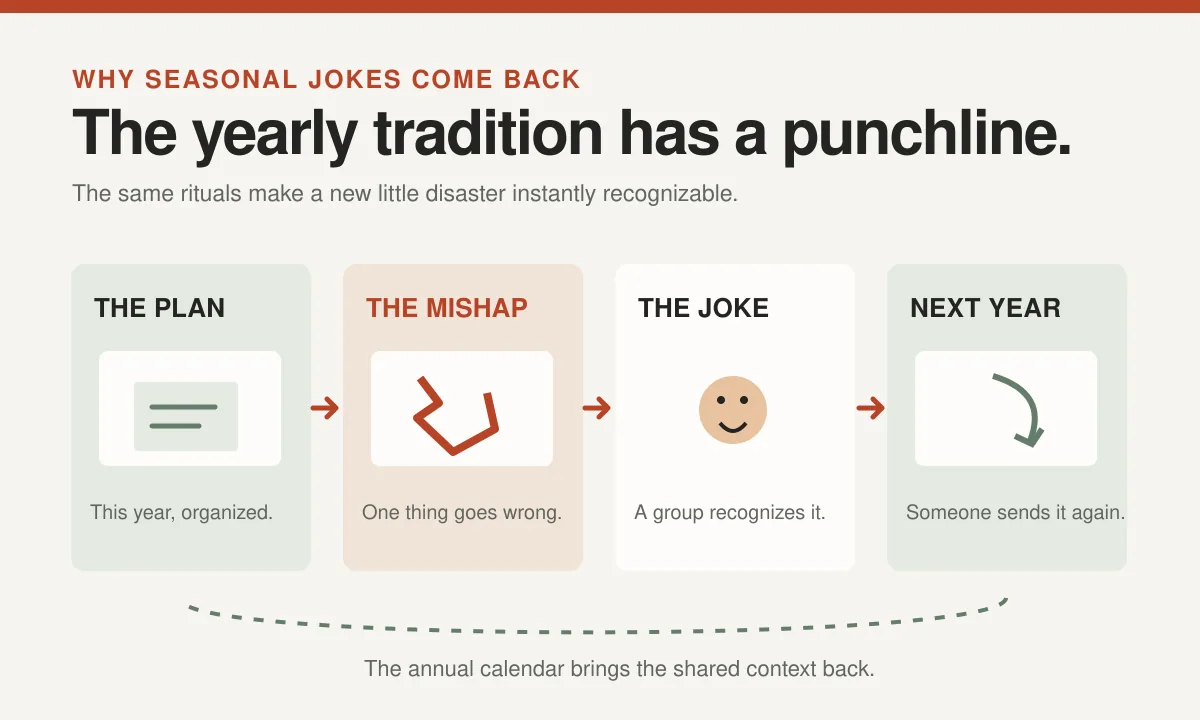
Anticipation makes small mishaps bigger
Holidays often come with plans. Somebody has chosen the meal, coordinated travel and promised that this year everything will be organized.
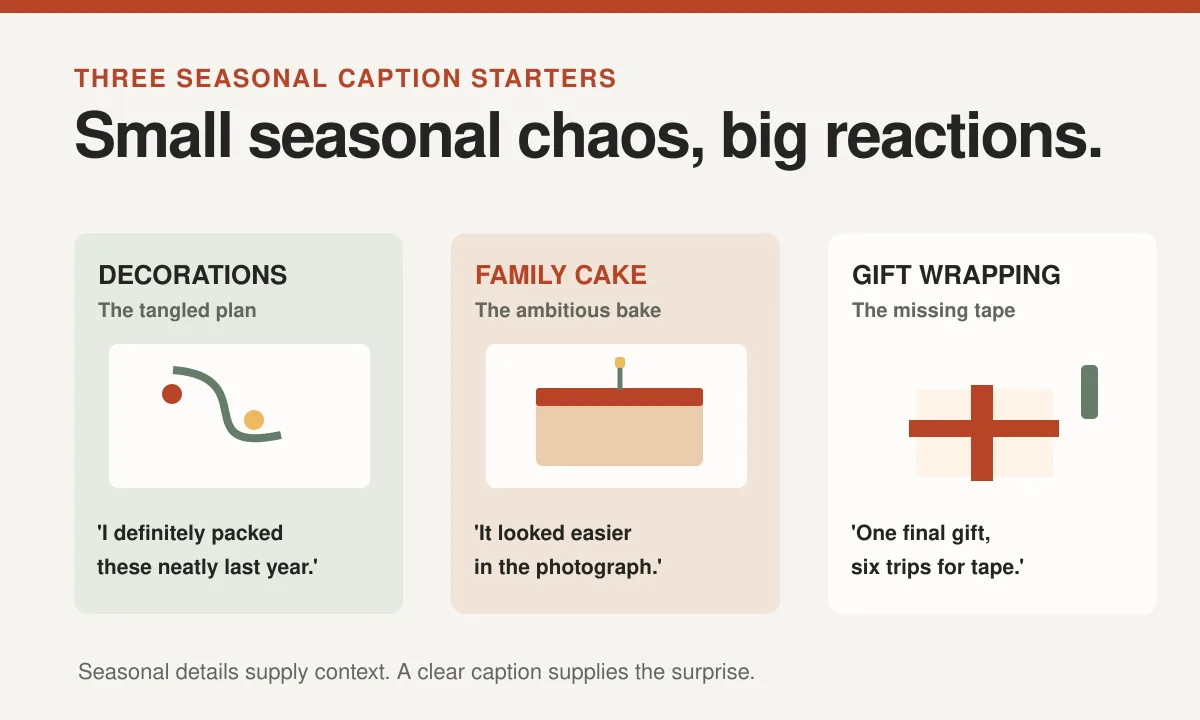
The comic twist appears when reality introduces its own schedule. The wrapping paper runs out. A cake looks nothing like the photograph. Someone has remembered the decorations but misplaced the table.
Exaggerating a minor mishap can create a cheerful, relatable joke. A defeated cartoon face beside the caption "Me discovering the tape has vanished halfway through wrapping" conveys the feeling without blaming anybody.
A serious problem deserves a different response. Travel safety, money worries or difficult family circumstances should not be dismissed because a holiday is approaching.
Our guide to turning awkward moments into punchlines explains how a little distance and the right target can make a harmless error funny.
| Holiday ingredient | Everyday equivalent | Why the joke lands |
|---|---|---|
| Shared rituals | Repeated routine | People recognize the setup immediately |
| Extra planning | Ordinary to-do list | Expectations make small setbacks funnier |
| Recurring family roles | A familiar group habit | Old references gain new meaning |
| Seasonal symbols | Everyday objects | A simple image signals the occasion |
The same faces return every year
Families and friendship groups often have repeated holiday roles. One person starts decorating early. Another arrives carrying more food than the table can support. Somebody insists that they know a shortcut and begins a spectacularly unconvincing explanation.
These roles can become affectionate inside jokes when the people involved enjoy them. A single reaction image recalls earlier gatherings without needing a lengthy recap.
The repetition can even make an old meme funnier. A cartoon character staring at an impossibly full shopping cart may have appeared every December for years. The person sharing it knows the group will understand the reference immediately.
Our article on family group-chat chaos explores why shared history makes small jokes feel personal.
Keep the teasing flexible. A relative shouldn't be permanently assigned an embarrassing role simply because one story was funny three years ago.
Seasonal symbols have ready-made comic potential
Holiday objects are wonderfully recognizable: decorative eggs, wrapping paper, heart-shaped cards, elaborate food and a surprisingly large number of items involving glitter.
Memes borrow those symbols and put them in unexpected situations. A rabbit can look like an exhausted event planner. A wrapped gift can appear to be hiding something with a complicated legal history.
The picture works because the symbol tells you which occasion is being discussed. The caption supplies the surprising detail.
You can see that approach in the funny Easter memes archive. An expressive animal or oddly arranged egg can carry a familiar seasonal joke without a paragraph explaining the calendar.
The symbolism should stay respectful. Humor about a celebration's everyday logistics is different from ridiculing somebody's religious beliefs or cultural practices.
Group chats amplify the shared experience
During a holiday, many people are living versions of the same routine at roughly the same time. They are preparing, traveling, cooking or recovering from the effort of finding a gift receipt.
A funny picture becomes an invitation to compare stories. One friend shares a disastrous wrapping attempt. Another responds with a photograph of a gift hidden behind an enormous quantity of tape.
The exchanges can feel lively because everyone has something relevant to add. A joke travels quickly through family and friendship groups, carrying new captions and local references.
Use the chat considerately. Important travel times and meal arrangements should remain visible. A flood of seasonal images can make it hard to find the address of the person who is hosting everybody.
Holidays can also be emotionally complicated
People experience holidays differently. Some look forward to large gatherings. Others find the travel, cost, memories or family expectations difficult.
A joke that seems harmless to you may arrive during a stressful moment for somebody else. Pay attention to how they are talking about the occasion before choosing an image.
A warm picture may suit someone who wants a gentle check-in. A sarcastic reaction might work with friends who are already joking about their own preparations.
The guide to sweet and sarcastic reactions helps with that choice.
No one needs to perform happiness for the group. If a friend prefers to skip the festivities, they can still be part of your everyday conversations without becoming a holiday punchline.
Holiday jokes also have a natural expiration date. A caption about assembling decorations may be hilarious while the room is full of boxes, then feel oddly out of place in the middle of spring. That doesn't make the image bad. It means the audience is responding to a shared moment, and the moment has moved on.
Save the good examples for when the occasion returns. Reusing a favorite can feel like a familiar family tradition, especially if the group recognizes it from previous years.
Save the joke that belongs to your people
The funniest holiday meme often combines a recognizable ritual with an oddly specific family detail. Perhaps the same decoration collapses every year, or somebody is famous for bringing an enormous dessert.
Choose a clear image, add a caption your audience understands and let the resulting conversation develop. A shared joke can become part of the tradition without needing to take over the day.
When the celebration ends, those little comic moments can be what everyone remembers. The decorations eventually come down, the last leftovers disappear and the group chat preserves a picture of a deeply unimpressed rabbit for next year.