Why Old Meme Formats Keep Coming Back
Discover why classic meme templates return, from nostalgia and familiar expressions to new captions, group-chat traditions and remixes.
Every so often, a meme format that seemed to retire years ago returns to your group chat with the confidence of a band announcing another farewell tour. The picture is familiar. The caption is new. Somehow, it works again.
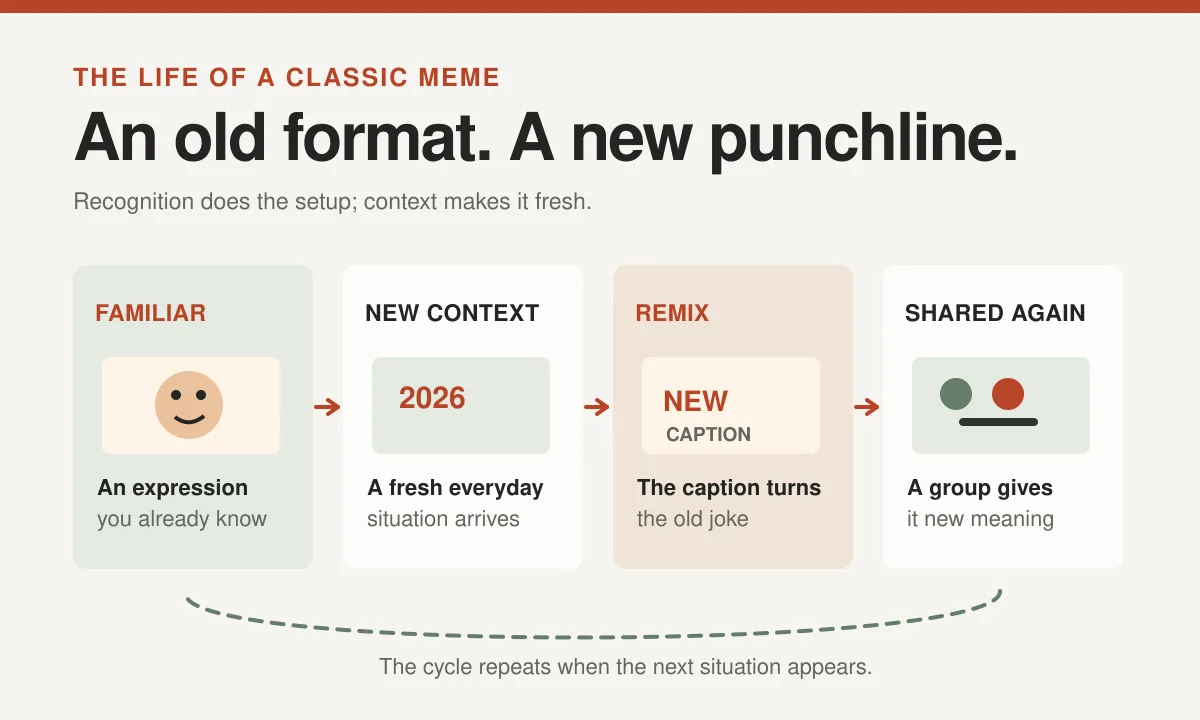
Old meme formats keep returning because people already understand their structure. A recognizable expression or template can turn a new situation into a joke in seconds. Nostalgia helps, but so do timing, shared references and the fact that the internet has never been particularly good at throwing anything away.
Familiar templates are quick to understand
A repeated meme format gives readers a head start. They may recognize the expression, layout or rhythm before they read the new caption.
That familiarity means the joke can focus on the fresh detail. The image provides a known emotional signal. The words bring it into a new situation.
Imagine a well-known character looking dramatically disappointed. One caption describes a printer breaking before a deadline. Years later, the same expression fits a cooking disaster or a surprisingly expensive train ticket.
The visual doesn't need to reinvent itself. The audience knows how to read it, and the new context does the interesting work.
Our guide to why reaction images can say more than a paragraph explains this kind of emotional shorthand.
Nostalgia adds another layer to the joke
A familiar image can remind people of earlier conversations, games, platforms or moments in their lives. Seeing it again may feel like unexpectedly meeting an old acquaintance in the supermarket.
The nostalgia isn't identical for everyone. A person who encountered a template as a teenager may have a strong association with it. A newcomer may simply appreciate the expression without knowing the history.
That difference can be funny in itself. One person says, "This is a classic." Another says, "I found this yesterday." Both may enjoy the same picture while having entirely different stories about where it came from.
Our article on how generations use reaction images explores why shared references vary without turning birth years into personality tests.
An old format doesn't have to be historically important to feel personal. Sometimes it merely reminds a group of a particular summer when everyone used the same ridiculous face.
The structure is easy to adapt
Many meme formats have a built-in pattern: expectation versus reality, before versus after, two contrasting choices or a person reacting to unexpected news.
Those patterns are flexible because they describe common human experiences. The specific subject can change while the relationship between the parts remains recognizable.
A two-panel comparison might begin as a joke about schoolwork and later become a joke about preparing dinner. The format supplies the rhythm; the caption supplies the new situation.
This also explains why a visual template can be reused across communities. Gamers, office workers and parents may adapt the same structure to very different everyday frustrations.
The best adaptations feel specific. Replacing one keyword with another without adding a new observation can make the joke feel stale.
| What brings it back | What stays familiar | What becomes new |
|---|---|---|
| Nostalgia | A well-known expression or format | The audience's memories and references |
| A current situation | A recognizable setup and reaction | A new event or everyday frustration |
| Creative remix | The structure or timing | An unexpected perspective or punchline |
New events give old images another chance
A meme format may return because a current event, release or shared situation makes its expression unexpectedly relevant.
A familiar picture of a character looking bewildered can feel fresh when a new software update changes a button everybody relied on. The template hasn't changed, but the experience has.
Seasonal moments can have the same effect. A joke about spending hours untangling lights may reappear each year because the underlying problem insists on returning too.
The article on why holiday jokes feel different describes how a shared calendar moment can make familiar material especially recognizable.
Timeliness gives the audience a reason to revisit something they already know. Even a dated picture can feel current when the caption describes today's tiny disaster.
Group chats keep formats alive
A meme doesn't need global popularity to remain useful. Within a family or friendship group, a particular image may become a running joke.
One person sends it after a failed attempt to organize dinner. Another uses it when a train is delayed. Eventually the picture carries an entire private history.
A newcomer may need a little context, but regular members recognize the reference immediately. The group has effectively given the image a second life, then a third, and possibly an honorary role in the household budget.
Our article on family group-chat humor explores how recurring references can become part of a relationship.
These traditions also explain why the same meme can feel hilarious to six people and ordinary to everyone else. The audience supplies extra context the picture cannot show.
Remixing a template can improve it
A format that once felt repetitive may become funny again when somebody changes its viewpoint, reverses the expected meaning or applies it to a surprising topic.
For example, a template usually used to show failure might be repurposed to celebrate an absurdly small success. The familiar layout creates an expectation, and the new use gently surprises the reader.
The update needs a clear idea. Adding more labels and louder colors isn't automatically a better joke. A sharp observation often gives a familiar image more life than elaborate decoration.
If you're creating your own variation, keep captions legible and think about whether the reader will understand the structure without several paragraphs of explanation.
For practical ideas, see how to write better captions.
Not every return is welcome
Some old templates rely on stereotypes, mean-spirited teasing or references that no longer feel comfortable. Nostalgia doesn't require you to preserve the worst joke from a particular year.
Look at the intended target and the people reading the new caption. A harmless exaggeration about losing your keys is different from reviving a format that mocks a real person's distress.
An image can also carry meanings beyond what you intend. If you're unfamiliar with the original context, investigate it before sharing.
Our guide on reading the room before posting something funny applies to revived formats as much as new ones.
A fresh caption is not a license to ignore somebody else's preferences or boundaries.
Old formats can still involve image rights
Familiarity doesn't mean a picture has entered the public domain. A film still, photograph or illustration can remain protected even after years of circulation.
Before placing a template on a public or commercial site, investigate the source and whether the intended reuse is authorized. A very old meme may be especially hard to trace because it has passed through multiple reposts.
The UK Intellectual Property Office guidance on online photographs explains that public availability alone doesn't grant permission to copy and reuse an image.
If you cannot clear a source, consider creating an original visual inspired by a general joke structure without copying protected artwork. The idea of a before-and-after comparison is not tied to one particular face.
Our image reuse guide covers the practical checks.
Keeping a favorite format fresh
When you find an old template you still love, ask what new experience it can express. Choose a recognizable situation, keep the visual legible and write a caption that adds a specific observation.
You can try a variation with close friends before sharing it more widely. If they recognize the joke instantly, the familiar structure is doing its job.
A successful revival doesn't have to dominate the internet. It only has to fit a moment well enough that someone smiles or sends it to another person.
The meme format may be old, but the late train, confusing password reset or mysteriously disappearing house key is happening right now. The internet has kindly kept a familiar expression available to provide commentary.